Letter to the Prime Minister of Australia (from the files of the Australian Archives)
Letter to the Prime Minister of Australia (from the files of the Australian Archives)
Honourable Sir
I have heard on the wireless the news that Australia would be willing to receive internees from England. I beg to protest; we have enough of the scum here already, too many in fact. I am not a vindictive woman, these aliens are God's creatures, just the same as we are. All the same, I sincerely trust that a U-boat gets every one of them. Faithfully yours, M. Gibbs, Shenton Park, Western Australia*
On 12 Jul 1940 a German U-boat tried to sink the British military transport ship, The Dunera, carrying 2700 mostly Jewish “enemy alien” internees.
Aged 16 to 65, the Dunera's motley cargo had fled to England from Central Europe to escape Hitler, were rounded up in mid-1940 on Winston Churchill's orders and were now on their way to Australia. (Nothing could convince Churchill that the refugees were not pro-Nazi, though he later called his decision to deport them a “deplorable mistake”.) On the Dunera's second day at sea, the German U-boat fired two torpedoes – Steven heard the first torpedo hit but didn't explode, the next torpedo missed. A Frankfurt newspaper reported that after the second torpedo was fired and the U-boat had surfaced, the crew found luggage bearing German labels floating in the sea and the commander decided not to attack the Dunera again. The Dunera's crew, by pillaging the POWs' suitcases and throwing them overboard, had unwittingly saved them all.
The Dunera landed in Sydney on 6 September 1940 and its passengers interned in labour camps, first in arid, outback Hay in NSW and later in Orange and Tatura.
After 56 overcrowded days at sea suffering dysentery and seasickness, many internees found the prison camp at Hay a relief. One said “it was heaven”, despite temperatures that sometimes soared to 43, no grass and a fence of triple barbed wire that brought back painful memories for some.
In late 1941, the Australian Immigration Minister gave the internees the option of enlisting in the Australian Army, remaining in the camps or returning to Britain. Nearly 1000 decided to join the army and stay in Australia, an incredible proportion later rising to prominence in academia, the arts, commerce and industry.
Among the so-called “Dunera Boys” were photographer Henry Talbot, Economics Professor Fred Gruen, Art Historian Franz Phillipp, professor and writer Fred Parkinson, leading Australian businessman Walter Heine, athletics coach Franz Stampfl, stockbroker Herbert Baer, composer Felix Werder and actor Max Bruch, to name but a few on a long roll-call of honour of this last convict from England.
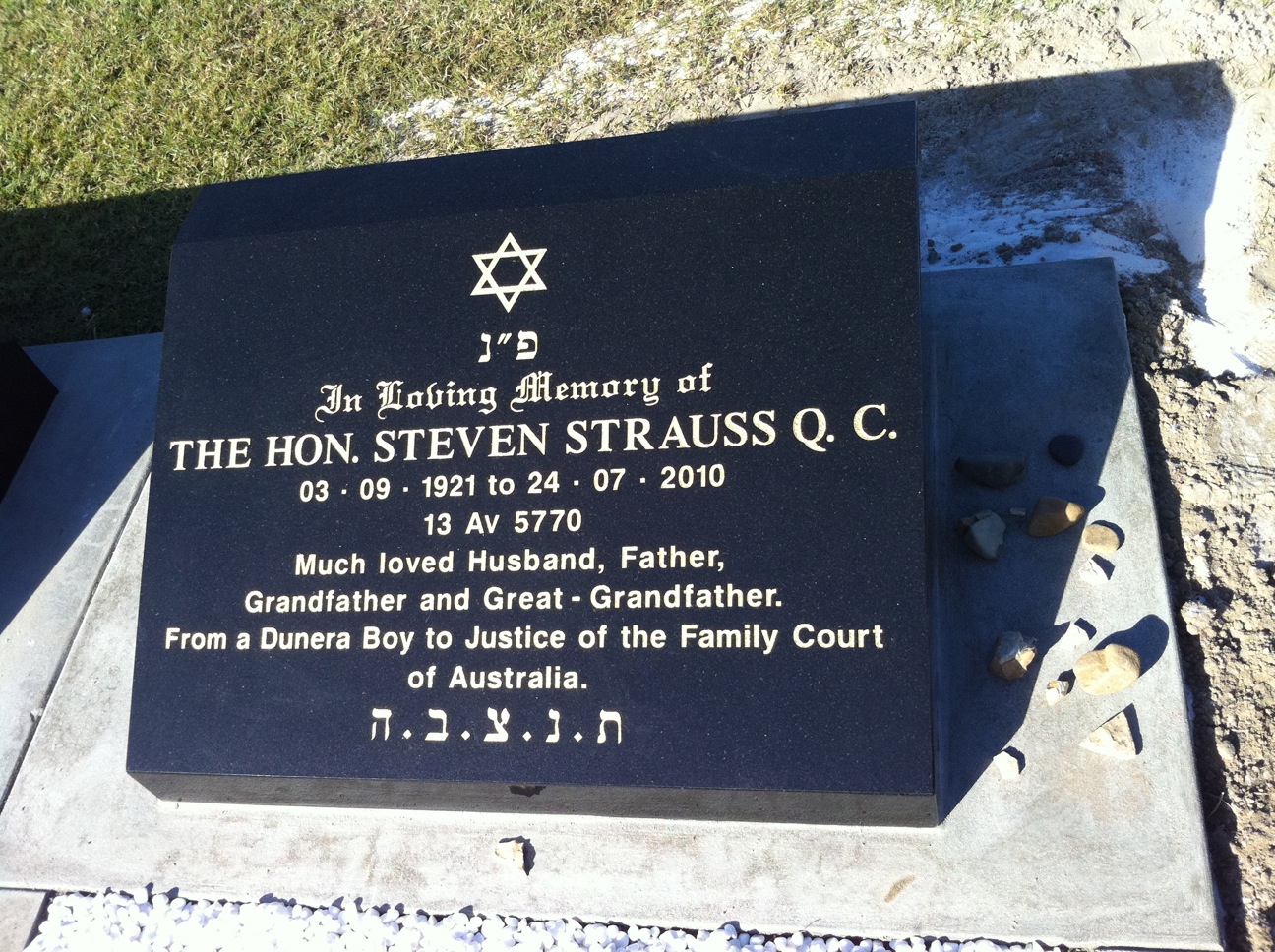
Another aboard the Dunera in 1940 was 18-year-old Steven Strauss, who studied for his School Leaving Certificate in the Tatura camp and won a scholarship to Melbourne University after serving in the army. Never one to boast himself, in 1950 he became the first lawyer born outside the Commonwealth to go to the Melbourne Bar. In 1965 he was made a Queens Counsel, another first for a lawyer born outside the Commonwealth, in 1976 a Judge of the Family Court and 1986 he was appointed to the court's permanent appeals division.
To him the Hay camp experience was “a little ripple in a big convulgence” and the twist of fate that led him to Australia was “the luckiest thing that ever happened to me”. He later told his son Simon that on en route to Hay, one of the Australian guards gave him an orange and he realised for the first time that he had come to a compassionate place.
Born in 1921 in the small town of Lauterbach in the state of Hesse in Germany, he was 12 when Hitler came to power. “In January 1933 I saw men in brown uniforms take away one of our neighbours because he was a communist. My mother told me she was glad my father was not alive. Things became difficult for me at school and my mother sent me away from Lauterbach to a Jewish boarding school at Caputh.
With the help of one of his former school teachers, Steven left for England in July 1939, aged 17.
“I went on a children's transport to England on 3 July 1939. I last visited my mother and sister in June 1939. That was the last time I saw either of them.''
“After my internment in 1940 I received several letters from my mother and sister, the last dated 30 March 1942. As I have since ascertained, my mother and sister were deported to a concentration camp in or near Riga shortly after.
“A survivor told me that my sister was taken out of the camp in a truck one day and did not return. I don't know how my mother died.”
Despite memories that sometimes made him scream in his sleep, Steven Strauss went on to lead a happy life in Australia until his death last week at 88.
In his speech given on his retirement from the Family Court in Melbourne in 1993, aged 72, he publicly described his early life in Germany for perhaps the first time.
“Before I say any more about the ship Dunera I want to say that Britain was one of the few places in the world which made it possible for a large number of children and youngsters to obtain shelter there on the same or a similar basis as I did. I am sure that if I had not got to England I would not be alive today.”
No account of Steven's life, however short, can ignore his sense of humour and the havoc it sometimes caused. Apart from his work – and he continued to work as a specialist consultant to a local family law firm until 12 months ago – his greatest loves were his family, his wife and his dog in equal measure. In his last years he was surrounded by them all and he never ceased to marvel at his good fortune.
When he passed away suddenly at his home on the Gold Coast, he was dressed for dinner, sitting in a chair and feeding wood into the fire in the dining room. Always the gentleman, he slipped away quietly and courteously with his dog at his feet.
The Honourable Justice Steven Strauss, born 3 September, 1921, died 24 July 2010.
Survived by his second wife Betty, his children Sybil, Simon, Sara and Stirling (Les), his step-children Julie and Scott McDonald, and his treasured grand and two great-grand children.
*Letter gratefully plagiarised from an article by Alan Gill, “When friends were enemies”, published in Good Weekend, I September 1990.
Farewell Speech - The Honourable justice Steven Strauss
